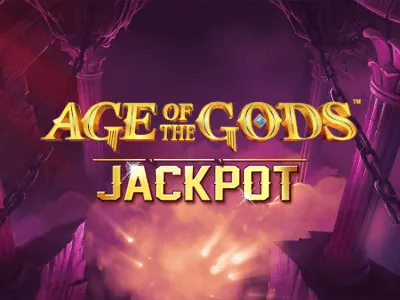
Age of the Gods, the cheapest jackpot in the business
Four levels across more than twenty-five slots sharing one pool, fed by 0.99 per cent of each stake, which is the smallest contribution anybody in this trade has documented.
Ad disclosure: some casino links are affiliate links; we may earn a commission at no extra cost to you. It never affects the order of our list or what a page says. 18+.
Nought point nine nine per cent
Of every documented contribution figure in this trade, the one attached to the Playtech series called Age of the Gods is the smallest by a distance. The original slot is quoted at 95.02 per cent in total (a figure from a review site, not from Playtech), of which 0.99 points are the jackpot share, which means the "pool" behind more than twenty-five games is fed by under one penny in every pound you stake.
Set that figure against the other end of the range, which is where the spread becomes faintly absurd.
Mega Moolah takes 5.30 per cent of every stake, and the published breakdown of a NetEnt title (Mega Fortune, at 96.60 per cent in total) puts 7.60 points of its return into the progressives, so the documented range across this business runs by a factor of nearly eight; writing "around one or two per cent", as almost every site does, is wrong at both ends. Wrong by a factor of eight!
A small "contribution" (the slice of each stake that leaves the game for the pot) has two consequences, and they pull in opposite directions.
The base game keeps almost all of its return, which is why these slots read as ordinary slots rather than as the 81 per cent machines of the Games Global catalogue, while the pool, on the other hand, climbs slowly, and the top level here seeds at €100,000 rather than at a million. The ladder has four rungs.
They are named "Power", "Extra Power", "Super Power" and "Ultimate Power", seeded at €50, €500, €5,000 and €100,000 (a factor of two thousand from the bottom rung to the top). Those seeds come from a review site rather than from Playtech (which publishes none of them), and the trackers confirm three of the four levels by name, which is about as close to verification as this series gets (three of four, from two independent directions).
A series built out of the Marvel wreckage
This is the part of the story that explains why a Playtech jackpot series of this kind exists at all, and the point to hold on to is that it is documented rather than inferred. Playtech once ran the Marvel slots. Disney, which owns Marvel, declined to renew the licence in 2013, because it did not want the brand associated with gambling.
The titles stayed online until the end of March 2017 and were pulled from the first of April (a date the trade press recorded at the time). What Playtech did next was engineering rather than invention, and it did not pretend otherwise.
It kept the game engines (which had been paid for already) and renamed them so that nobody would notice: The Avengers became Age of the Gods, Fantastic Four became Age of the Gods: Furious Four, and Iron Man 2 became Age of the Gods: King of Olympus. The original slot had already appeared on 11 July 2016 (nine months before the Marvel games went dark), which is why the dates confuse people.
So the series a player opens today is a pantheon laid over superhero mathematics, and the thirteen titles we could name from third-party sources (no official "series list" exists) read accordingly: God of Storms, Hercules Rules, Medusa & Monsters, Prince of Olympus, Rulers of Olympus, Goddess of Wisdom, Fate Sisters and three Norse games among them.
Playtech publishes no official list of the series, which means that count is a floor rather than a total, and that anybody who gives a precise number is guessing. There is one question we cannot answer, and so far as we can tell nobody else can answer it either.
What became of the Marvel Mystery Progressive Jackpot after April 2017, how it was paid out, and to whom, is undocumented in every source we read, and in our view a guess dressed as an answer would be worse than the gap!
The one network where the feature fires in the same session
The trigger is random, on any spin, and the "award" screen is unusual enough to describe in full: twenty gold coins, which a player uncovers one at a time until three matching coins name the level that has been won (three of twenty, which is not a long game). There is no symbol combination to hit, no payline to fill and no "qualifying stake" declared anywhere by Playtech or by an operator that we read;
The observed intervals are what make this series worth a page of its own, because the bottom of the ladder behaves like nothing else we have measured on this site. On the readings of 18 October 2026 the "Extra Power" level had been falling every two hours and thirty-eight minutes on average; the "Super Power" every day and nine hours, and the "Ultimate Power" every seven weeks (seven weeks and three hours, to be exact about it).
The bottom level is not tracked at all, and the likeliest reason is that it falls too often for anybody to think it worth monitoring. A "pool" that pays something every few hours is a genuinely different product from one that pays once a year, and that is why we would say a player can expect to see this feature rather than hear about it afterwards.
What the series does not have, after ten years of running, is a settled record of its own. A "tracker" gives the largest "Ultimate Power" ever paid as €984,763, while an affiliate site claims $1,186,695 on 19 December 2020 (a different currency, and a figure twenty per cent higher), and the two cannot both be right. We print both figures and call the record unestablished, which is unsatisfying and is still better than choosing one.
Age of the Gods
Playtech
- Levels
- Four: Power, Extra Power, Super Power, Ultimate Power
- Trigger
- Random on any spin, then a screen of twenty gold coins
- Award
- Uncover coins until three matching ones reveal the level you have won
- Contribution
- 0.99 per cent of the stake on the original title, the lowest we found anywhere
- Size of the series
- Over twenty-five slots, all sharing the same pool
- Where it came from
- The retired Marvel slots: Disney did not renew the licence, and Playtech reused the engines
The rest of Playtech, which is thirty pools rather than one
Age of the Gods is not the Playtech network, for the simple reason that Playtech does not have one.
It has dozens of parallel pools (thirty of them appear in the trackers we read), most of them tied to a single game or to a single series, and the aggregate across all of them is enormous: in the twelve months to July 2019 the company declared €187,629,964 paid in jackpot prizes (its own figure), at an average of 16,037 jackpots a month. The spread between those pools is the widest of any supplier, and reading them against their own average intervals sorts the living from the dead:
- Jackpot Giant, the largest of them, paid €10,710,483 on 20 October 2018 and €7,995,563 on 14 August 2026, on five wilds landing on line one (line one, and no other)
- Beach Life has paid £4.4 million in February 2012 and £3.7 million at bgo in July 2015, where the second came from a £10 spin that returned 379,904 times the stake
- the DC Super Heroes pots are alive at all three levels, the smallest falling about every two days and the largest, the "Grand", about every three years
- Everybody's Jackpot falls every two weeks and two days, which makes it one of the most frequent single-game pools anywhere
- Kingdoms Rise Epic has not paid for an average of four years and fifty-one weeks, and Thai Temple for eleven years and seven weeks
Those last two are not "networks" in any useful sense any more, and a casino page that lists them beside the others, as though they were comparable, is telling you nothing at all.
One further correction belongs here, because we have seen it repeated on page after page: Fountain of Youth is described on several sites as a Playtech jackpot network, and it is a three-reel slot released on 21 December 2015 with a return of 96.81 per cent and a fixed maximum of 800 times the stake (fixed, which is to say paid from its own mathematics and not from a pool). It appears in no progressive tracker, and fixed jackpots is where it belongs.

A casino for the Playtech pools
Malta Gaming Authority · Kahnawake
18+ · Sponsored link · Terms on the operator's site
What we would check before playing one of these
Two checks are worth making before a first spin, and the first of them costs nothing. Look at which level the "counter" on the screen belongs to (the screens name it), because on this series the four are separated by a factor of two thousand, and the one that pays every few hours is not the one printed in the marketing. The second check is the title itself, which is where the money actually changes.
The series shares one pool across more than twenty-five games, so the "pot" on the screen is identical wherever you choose to open it, and the only thing that differs is the "base game" underneath it; Playtech publishes the return of individual slots and not a breakdown, so those 0.99 points are the only part of the arithmetic we would quote with any confidence.
How a pot grows has the documented figures for every other network, and the records has what each of them has actually paid (with the date, and the currency it was paid in).
A British house carrying the series
 Amazon SlotsGambling Commission · Alderney AGCC · AGCO and iGaming Ontario, through Six Gaming LtdVisit
18+ · Sponsored link · Terms on the operator's site
Questions
What percentage of the stake goes into the Age of the Gods jackpot?
0.99 per cent, on the figures quoted for the original slot, which has a total return of 95.02 per cent. That is the lowest contribution documented for any network on this site, against 5.30 per cent on Mega Moolah and 7.60 points on one NetEnt title.
How often does the Age of the Gods jackpot pay?
It depends entirely on the level. On the readings of 18 October 2026 the Extra Power level had been falling every two hours and thirty-eight minutes on average, the Super Power every day and nine hours, and the Ultimate Power every seven weeks. The bottom level is not tracked, probably because it falls too often.
How is the Age of the Gods jackpot triggered?
At random, on any spin, with no symbol combination involved. The award screen shows twenty gold coins, and a player uncovers them one at a time until three matching coins name the level won.
Is Age of the Gods related to the Playtech Marvel slots?
Directly. Disney declined to renew the Marvel licence in 2013, the titles were pulled from 1 April 2017, and Playtech reused the engines under new names: The Avengers became Age of the Gods, Fantastic Four became Furious Four and Iron Man 2 became King of Olympus.
What is the biggest Age of the Gods win?
Unestablished. A tracker gives the largest Ultimate Power as €984,763 while an affiliate site claims $1,186,695 on 19 December 2020, and the two figures are incompatible. We print both rather than choose.
Is Fountain of Youth an Age of the Gods jackpot?
No, and it is not a progressive at all. It is a three-reel Playtech slot released on 21 December 2015, with a return of 96.81 per cent and a fixed maximum of 800 times the stake, and it appears in no progressive jackpot tracker.